Monday, April 20, 2015

Central Banks Cannot Create Investment Via the Printing Press


Richard Duncan, a former World Bank employee, has posted an article that discusses his belief that QE is a form of debt cancellation that will allow governments to leverage up and make new growth inducing investments.


The Duncan argument runs as follows:
1) Central banks create money from thin air and buy government debt.
2) As governments owe money now to the central banks, and since central banks return all of their proceeds to the government, governments actually become less leveraged as central banks print.

Conclusion: This means that governments can really lever up now and invest in things that will create growth for the future in combination with central bank money creation from thin air.
The problem with this argument is that the second premise is demonstrably false. When central banks buy government debt, they issue a new form of debt, currency. This currency is also debt. Look at any central bank balance sheet and you will see it show up as a liability, just like every other form of debt.
Currency is slightly different from government debt in that it doesn't have a maturity date or pay interest. It is zero coupon perpetual debt. Nevertheless, it represents the same kind of claim on goods and services as the government bond. That is, $1000 in cash has the same purchasing power as a bond that sells for $1000. Nothing has really changed with the central banks money creation gambit, except for one small wrinkle.
Unfortunately, the small wrinkle completely destroys Duncan's conclusion that central bank printing will allow us to create new investment for future growth.
When central banks print money from thin air and buy bonds, they artificially push interest rates down. That is, to induce the holder of the bond to sell to them, the central bank must bid up the price of the bond above where it would normally trade, driving down the interest rate associated with the bond.
There is a funny thing that happens to the rate of savings when you do this however, it falls. As the central bank shifts the supply curve of money to the right, we see that rates will fall, all else being equal. This means that the interest rate is now below the equilibrium rate for the supply and demand for savings. This induces people to save less and consume more.
We can see now that Duncan's prescription of more central bank printing will bring about the exact opposite outcome of what he believes will happen. There will be less savings and investment available with more central bank printing. Investments require savings as someone somewhere has to defer consumption of their output in order to be able to lend it out so that the workers erecting a plant, or software coders creating an app or actors and technicians filming a movie can be paid and survive until the fruits of their labor are completed and their investment can start to earn a return.
Duncan, like most economists, confuses cash with savings. They are not the same thing. Savings, deferred consumption, is required for actual investment. Cash gives you a claim on that savings, but it not only doesn't create savings, the creation of cash destroys the incentive to save. Cash creation causes less investment, not more as Duncan hopes.
Duncan's argument is the equivalent of saying that central banks can create output, that they can just print up barrels of oil, employee retraining systems and jobs. They, of course, can do no such thing. Their money creation from thin air actually destroys future output (less savings means less growth) and creates malinvestment (malinvestment being a topic for another time).
Think about it like this, if money creation from thin air creates investment opportunities as Duncan proposes, why is the rate of savings and investment so weak? Why don't business invest more with the free money?
The reason that they don't is that they couldn't even if they wanted to as the savings doesn't exist at this level of consumption given the artificially low interest rates. If you want more savings and investment, you need higher rates and, therefore, less central bank printing. Duncan has it all backwards.

 Disclaimer: Nothing on this site should be construed as investment advice. It is all merely the opinion of the author.

Wednesday, April 15, 2015

Larry Fink's Muddled Thoughts


Larry Fink, CEO of the world’s largest asset manager, has sent a letter to the CEOs of the 500 largest companies in the U.S. admonishing them for returning too much capital to shareholders.

The New York Times story on this tells us that Mr. Fink believes that such activity is detrimental to investors and the companies themselves. He believes that everyone is thinking too short-term, that we have become a “gambling society.”

Well, Mr. Fink is correct, there does exist a capital allocation problem in the world today. The problem is that Mr. Fink is chastising the wrong groups.
  
Investors and businesses alike have an incentive to maximize their own profits. When interest rates are set at zero, as they are today in the U.S. and below zero in much of the rest of the world, it is quite impossible to get these two groups to focus on the long-term.
  
When central banks peg rates at artificially low levels, two things will happen:

First, savings will fall. At artificially low interest rates, savers have less incentive to put off consumption.

Second, investment rates will naturally decline with the decrease in the savings rate. Also, the natural reaction of businesses to artificially low rates is to reduce investment. Since businesses will invest to the point where marginal cost equals marginal return, with interest rates set at zero, the marginal return on investment will also be zero. There is no incentive to invest. In fact, without savings, they couldn’t invest even if they wanted to.

This is why businesses want to return capital to shareholders. Business and people are reacting rationally to the interest rates forced upon them by central banks. There is no point to saving and investing if returns are set at zero. At an interest rate artificially set at zero, you will get neither savings nor investment.

Mr. Fink does not properly recognize who the culprit is in our live for today, gambling culture. It is the central banks that have created the mess. Everyone is forced to deal with the state planners and their arbitrary and foolish interest rate edicts.

Given that he doesn’t understand the problem, Mr. Fink moves on to proposing the wrong remedy.

Mr. Fink’s solution to our problem is to adjust the tax code. He wants to increase the tax rate on holdings of less than three years to the ordinary income tax rate, whereas today we tax holdings of longer than one year at a lower capital gains rate.

Mr. Fink states this, “would create a profound incentive for more long-term holdings and could be designed to be revenue neutral.”

It would do no such thing. Without a higher, market-based rate of interest, savings levels will be artificially low. Remember, if returns are set at zero, there will also be no income to tax. Taxes are not the driving factor here. If you want more investment, eliminate the Federal Reserve. Let the market determine rates.

The New York Times seems to believe that Mr. Fink’s asset management business has something to gain and little to lose via these suggested changes to tax policy, as they tend to hold investments for some time.

I suspect that Mr. Fink’s real concern is, or at least it should be, that his business is tremendously threatened by the choices that people and businesses are making today. Mr. Fink’s business is managing the savings of people and investing those savings in businesses. If there is no savings, and businesses liquidate, there will not be much for Mr. Fink or his employees to do in the future. Societal capital is being liquidated and Mr. Fink’s business is, therefore, under threat.

No one can rationally allocate capital in this environment. Savings and consumption patterns are being massively distorted by central bank interest rate policies. No one knows the real demand for their products, where they should be sourced from, where they should find the capital to produce them or if they should produce them at all.

Under such conditions, I am certain that corporate CEOs are paying too much to buyback their shares, but they feel forced into this situation because they know that returns on capital that they may invest in plant and equipment are guaranteed to earn zero. They are being as rational as possible given the information that they have been provided by the artificially driven financial markets. Additionally, the real capital, savings, required to increase investment does not exist. Even if executives were to heed Mr. Fink's plea, they couldn't comply.

They think their current cap rate on share buybacks is maybe 3%, and this far exceeds the zero percent that they will earn if they reinvest in their businesses. Share repurchases also push share prices up, and this is not something that too many shareholders, other than Mr. Fink, complain about. Unfortunately, the three percent is also overstated since they will certainly see returns fall in the future as they continue to liquidate their businesses. In the minds of CEOs this is a problem for tomorrow, however.

Central banks have created quite a mess, and tax policy cannot fix it. There can be no rational capital allocation or an increase in the amount of savings and investment as the interest rate required to produce such a result is being massively suppressed by the central banks.


Disclaimer: Nothing on this site should be construed as investment advice. It is all merely the opinion of the author.
Wednesday, March 18, 2015

I, Pencil

Jon Hilsenrath is at it again, a front page story in the WSJ on whether the word "patient" will remain or be removed from the Fed's release today. I cannot comprehend just how emasculated the free market has become.

Our energies as investors are now singularly tied to a few words from a dozen extraordinarily powerful people in Washington D.C. (powerful, because they can create money from thin air and legally steal from some to give to others) setting interest rates for a planet of billions of people, and they have absolutely no idea of what they are doing. Yet, they set the single most important price in the world on nothing more than a whim. Their actions then distort the actions of the billions of hard working people of this planet, and all this is because investors want to seemingly believe that these few people know how to price money, the basis for the  allocation of savings and, therefore, the creation of all goods and services.

As I was thinking about this my mind wandered back to an article I first read close to 20 years ago as I began this, I shall call it perilous, journey towards the discovery of Austrian Economics. It was entitled I, Pencil, and it was written in the late 1950s by Leonard Read, the founder of FEE.

It is just a few paragraphs long, and it is about just how miraculous is the manufacture of a simple pencil. It has just a few ingredients, wood, graphite, metal and rubber, but it so complex that not a single person on the planet could make one alone.

He talks about the wood, cut down from cedar trees in Oregon by loggers using tools. Tools like chainsaws, rope and logging equipment, each manufactured by thousands of others. The metal for the equipment was mined in far away places, treated and processed in plants built by countless thousands.

The logs are shipped to a plant on roads built by people who had no idea that their efforts were critical to the manufacture of the pencil on your desk. Read goes through a little exercise like this for each of the basic parts of a pencil and demonstrates that the manufacture of a pencil is really a miracle.

Most importantly, he points out just how fluid is the entire process. No mastermind is required to produce a pencil. No single mastermind could comprehend it all. Millions of freely associating individuals around the globe must voluntarily act to achieve the miracle of a manufactured pencil. Socialism, however, marches on and today  I sit here awaiting the command from above on the word "patient" and what it will mean for the price of money. They, the Federal Reserve, will get it wrong with regard to interest rates because, just as in pencil manufacturing, no mastermind can comprehend the workings of an entire market. The game that we are forced to play as investors today is ridiculous.
If people could comprehend the miracle of the pencil and its manufacture I think that we could quickly kill the socialistic Federal Reserve and all of the other central banks of the world.

If you have never read I, Pencil, I encourage you to do so. It takes five minutes. There is also a five minute companion video that is excellent:

http://www.econlib.org/library/Essays/rdPncl1.html

https://www.youtube.com/watch?v=IYO3tOqDISE

 Disclaimer: Nothing on this site should be construed as investment advice. It is all merely the opinion of the author.

Sunday, February 8, 2015

Even Squirrels Fall From Trees


Shanghai Gold will change the current gold market “consumption in the East priced in the West” situation.

Xu Lode
Chairman
Shanghai Gold Exchange
May 2014


Confidence in our determined cabal of global central bankers had never been higher than on the morning of January 15, 2015. Investors were convinced that central bankers had the global stock, bond and currency markets under their complete control and no great harm cold be done to them.

Then everything changed.

The Swiss, who had pegged their currency to the euro in 2011, and who had pledged to maintain the peg just days prior, suddenly had a change of heart and the let the peg go.

Instantly, the Swiss franc vaulted as much as 30% higher versus the euro. Those who had been shorting Swiss francs against the euro in order to generate cheap carry-trade financing were destroyed.

This was something investors had not prepared for. For the past fifteen years, central bankers had been telegraphing their intentions to investors well ahead of acting. Investors felt that central bankers now owed them a heads-up before they changed policy and invested as if this were a pact ordained by God.

Like seeing a squirrel fall from a tree, no investor ever expected to see a sudden and rash move from a major central bank, though both of these things do happen.

The peg seemed to have been set in concrete, allowing investors to utilize leverage in this carry-trade. The lifting of the peg, therefore, was catastrophic for those positioned the wrong way.

For those unfortunate speculators, the trade had seemed to be a sure and simple one. With the peg in place, there seemed as if there was no risk in leveraging up and shorting the franc versus the euro. For those on the other side, buying protection was cheap because everyone believed the peg would never be broken.

This set up a potentially very asymmetric outcome; the franc almost couldn’t fall against the euro while the upside for the franc was enormous.

This ends our history lesson.

As I look around the world today, it seems to me that nearly every investment opportunity possesses an asymmetric outcome quality. Equity market capitalizations seem to be at all-time highs relative to GDP. Interest rates are at multi-century lows. Art prices are in the stratosphere as a Gauguin painting just went for $300 million.  Everything seems to have been taken to an extreme. Everything seems to be a one-way bet with no possibility given to any chance of a reversal.

The gold market is another of these places that appears to have all of the hallmarks for a potentially asymmetric outcome. In gold’s case, however, market participants scream that “down” is the only possibility for gold’s price.

For years, commercial participants (namely bullion banks) going short gold has been a signal to the marketplace that gold’s price is headed lower. Below, crushthestreet.com shows us graphically the relationship between aggressive commercial shorting and the subsequent downturn in gold’s price:


Gold And Silver COT Report Rally Could Be Short-Lived


The relationship has been a strong one and, like the Swiss franc trade, there seems as if there is some easy, low risk money to be made here.

There are a few caveats, however.

First, despite some serious effort on the part of the bears, it has been difficult to move gold’s price below $1200/oz. for any length of time. That is, with the price today at $1233, there doesn’t seem to be much money to be made by aggressively shorting gold.

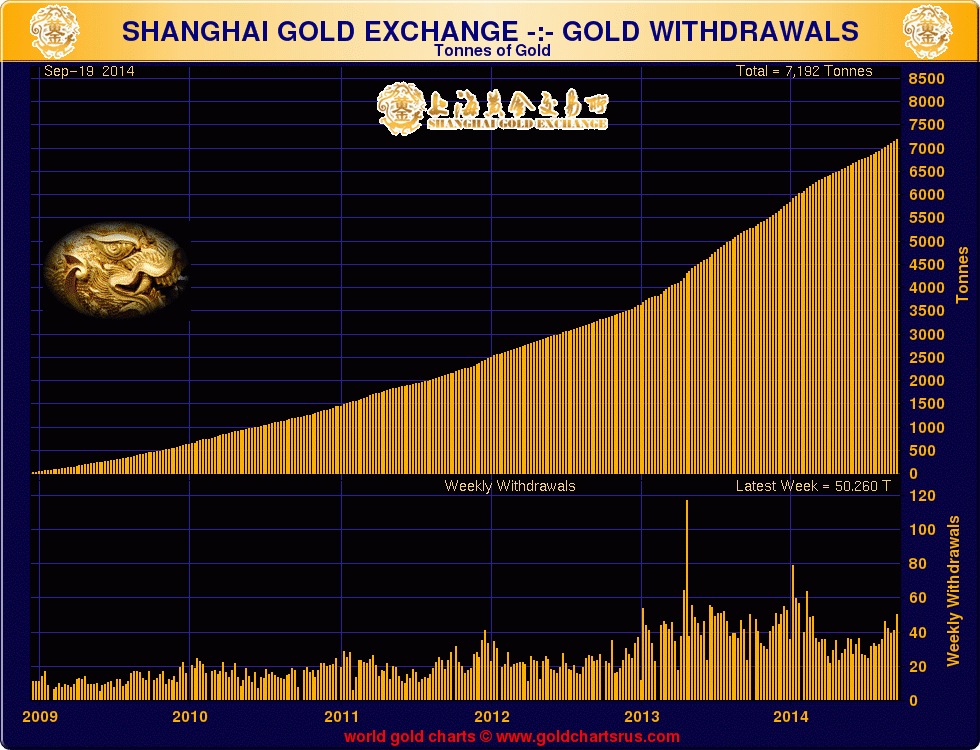
The reason that the bears haven’t been able to push gold’s price to new lows is that China has been an insatiable buyer at these low prices. As Koos Jansen at Bullion Star informs us, Chinese off-take in the month of January was 255 tonnes, nearly all of the gold mined in the world in the month of January.

We can see via this graph from goldbroker.com that China has been serious about accumulating gold for quite some time:


The curious thing about all of this shorting of gold that happens at the COMEX and is reported via their weekly commitment of trader’s report is that there exists almost no physical gold to back up the trades. Currently, there exists about 770,000 ounces of registered gold in COMEX warehouses that are available to settle open trades.  Open interest is about 430,000 contracts and represents potential claims on 43 million ounces of gold. That is, there are potential claims on about 56 ounces of  gold for every actual ounce of gold in COMEX warehouses.

It remains shocking to me the level of potential risk that the shorts on the COMEX are taking in the gold trade.

This brings us back to our opening quote from the chairman of the Shanghai Gold Exchange. He is expressing frustration that China now dominates the physical gold market while unbacked paper gold sales in the West dominate pricing, and he intends for this to change.

To sum up, China is buying huge quantities of physical metal supporting gold’s price at around the $1200 level for most of the past two years. They are upset that the West still dominates the pricing of gold in the marketplace. There exists only about $1 billion in registered gold in COMEX warehouses and everyone seems to think that gold’s future price has only one possible direction, down. 

For as little as $1 billion, China could break the COMEX gold shorts at any moment that they choose. Sure, at higher prices some more gold could be made available, but suppose China owned half of the open contracts on COMEX and demanded delivery. We are still talking about peanuts here to destroy Western short positions, and all the while central banks continue to print unbacked fiat money like crazy.

I am not suggesting that I know which way gold’s price will move in the near future, but I can see that the gold market has all of the hallmarks of a potentially very asymmetric trade.

Then again, why should gold be any different than any of the other markets that I see around the world?

It may be wise to remember that despite the present understanding of market participants that every trade is just a one way bet these days, squirrels do sometimes fall from trees.  When everyone is on one side of a trade, as we saw in the Swiss franc market, reversals can be violent. 

 Disclaimer: Nothing on this site should be construed as investment advice. It is all merely the opinion of the author.

Wednesday, January 28, 2015

Theater of the Absurd


Central bankers are the key actors in our current economic theater of the absurd. It would be impossible for me to take them seriously if not for their nearly unlimited power. Watching these people operate in the financial markets is sort of like watching a ten year old drive a Ferrari. There is just a little too much horsepower under the hood given the limited abilities of the driver.

Finally, Mario Draghi appears to be able to deliver on his “whatever it takes” promise and we will see the Eurozone commence with a 60 billion euro per month money printing and financial asset buying orgy.

This is having the typical inflationary impact on financial asset prices that we have come to expect from the out of control world of central bankers.

In the Eurozone alone yields on more than 1.4 trillion of assets have now gone negative as prices are bid up in front of the coming central bank buying:

 http://www.zerohedge.com/sites/default/files/images/user5/imageroot/2015/01/negative%20yields.jpg

Worldwide, Bloomberg reports that more than $4 trillion of sovereign bonds carry a negative yield.

The implications of this are fascinating. For example, quite soon we should expect gold to become the world’s highest yielding asset as a result of this latest central bank foolishness, and I am sure that this move to ultra low and negative bond yields is putting the recent bid under the price of the yellow metal.  Central banks are powerful, but they can’t control everything and I am sure that gold’s recent lift in price has annoyed them somewhat.

The new European QE is going to see central banks trading away currency that yields zero in order to buy assets with a negative yield. Just brilliant!

No private investor would enter a carry-trade like that, but it is just another day at the office in the world of central banking.

The absurd implications of negative sovereign yields are also quite incredible:

Governments can deleverage by increasing the amount of debt they now issue. Issue enough debt with a negative yield and at maturity you can be debt free, or even generate some equity.

Taxes are not required in a land where investors are keen to finance the government with negative yields.  Just imagine the social implications of this once the voters figure it out.

Heck, if money printing can create wealth and if sovereign bonds really are worth more in real terms because of the printing press, then not only can taxes be easily dispensed with, but so can all work. 


Adding to all of the absurdity of negative yields is the fact that it is occurring precisely because of central bank induced inflation. In a bizarre “Emperor’s New Clothes” sort of way, Draghi can’t see the obvious inflation that he is creating, and the crowd of investors, for the moment, is going along with it.

Draghi at his recent press conference when asked if money printing will lead to inflation:

 I think the best way to answer this is, have we seen lots of inflation since the QE program started? Have we seen that? And now it's quite a few years (since) we started. You know, our experience since we have these press conferences goes back to a little more than three years. In these three years we've lowered interest rates, I don't know how many times, four or five, six times maybe. And each time someone was saying, ‘this is going to be terribly expansionary. There will be inflation.’ Some people voted against lowering interest rates way back at the end of November 2013. We did OMT. We did the LTROs. We did TLTROs. And somehow this runaway inflation hasn't come yet. So what I'm saying is that certainly the jury is still out. But (there) must be a statute of limitations also for the people who say there will be inflation. Yes, when please? Tell me within what?”

Clearly, in Draghi’s mind the increase in prices, and yield declines, in the sovereign bond market that he has induced (with the aid of other central banks, of course) doesn’t represent inflation. I beg to differ as this sure looks like price inflation to me:

Greece Ten Tear Bond Yields


Italy Ten Year Bond Yields


Portugal Ten Year Bond Yields


Source: Trading Economics

Negative sovereign bond yields in major countries and a collapse in the yields of the bonds of less fiscally sound countries like Greece, Italy and Portugal are symptoms of monetary inflation and they serve to distort the structure of the economy and create malinvestment as do all prices that are artificially manufactured.

The financial world has entered the realm of the surreal, and it would be fascinating to watch if its consequences weren’t quite so dire. 

 Disclaimer: Nothing on this site should be construed as investment advice. It is all merely the opinion of the author.

Sunday, December 14, 2014

Oil


The most important thing is this (oil price collapse) is a massive tax cut for the world. This is really good stuff for the world.

Larry Fink
CEO Blackrock
December 11, 2014


Lower oil prices are like a tax cut to the economy, so in terms of macroeconomic impact, it’s a positive.

Jacob Lew
U.S. Treasury Secretary
December 11, 2014


Despite the impressive recent gains in natural gas and crude oil production, the U.S. is still a net importer of energy. As a result, falling energy prices are beneficial for our economy.

Over the near term, this will lead to a significant rise in real income growth for households and should be a strong spur to consumer spending. Since energy expenditures represent a higher proportion of outlays for lower income households, falling energy prices disproportionately raise their real incomes. Also, because such households are more liquidity constrained, with budgets that often bind paycheck to paycheck, they have a higher tendency to spend any additional real income.

As a result, much of the boost to real household income from falling energy prices is likely to be spent, not saved.

Bill Dudley
President New York Federal Reserve Bank
December 1, 2014


Here we have the head of the world’s largest asset manager, the CFO of the U.S. government and the globe’s chief money printer and regulator of the world’s most important banks all telling us that crashing oil prices are a good thing. Consumption will go up and savings will fall as a result of lower oil prices and these are, allegedly, good things.

Personally, I have never seen an issue that more starkly contrasts the Keynesian view of the world, as referenced above, with that of the Austrians.   

Keynesians focus on GDP, aggregate demand and animal spirits. Austrians focus on savings and capital creation, the entrepreneur’s focus on wealth creation and the avoidance of the malinvestment that comes from money and credit creation from thin air.

Keynesians want to boost consumption and penalize savings following a bust by artificially pushing interest rates lower. Austrians want to point to rates being too low during the bubble phase as being the cause of the subsequent crash and economic hangover and they argue that lower rates for longer will only create bigger problems in the future.

Oil’s collapse gives us a perfect perch from which to compare these contrasting economic views.

As we saw above, the typical Keynesian view is that the oil price collapse should increase consumer demand and decrease savings. These are thought to be good things.

Austrians view the oil price collapse with horror. Savings (real capital) was wasted on a truly epic scale as malinvestment ran amok throughout one the world’s biggest and most important industries. This is an industry that has seen annual upstream capital expenditures increase by about 75% to nearly $700 billion in the past five years. Pretty much all of that spending appears to have been wasted.

How could this happen?

Keynesians, it seems, don’t really care about the cause of all of this wasted capital. In the U.S. and Europe the only concern seems to be with whether or not the oil price collapse will lead to increased consumption and decreased savings. Both of these effects are cheered on by the Keynesians.

Austrians point to artificially low interest rates as having impacted the structure of production and consumption. Artificially low rates appear to have been a prime mover in China’s titanic infrastructure build-out of the past five years. This created a nearly insatiable demand for energy on the part of China, the major incremental driver of nearly everything on the planet for much of the recent past. This demand drove oil prices relentlessly higher over the past few years.

Alas, the Chinese real estate miracle appears to have crested and, with real estate prices starting to fall, the infrastructure build-out has stalled. Energy demand is, therefore, falling relative to previous expectations.

Oil production, especially in the U.S., boomed with the rise in capital spending that came from artificially low interest rates and strong, but artificial, oil demand. Despite the overall fall in savings in the U.S. over the past decade, whatever remained of the pool of savings was made available for oil production. In fact, oil production in the U.S. is up about 80% from its low point and the high yield market has come to be dominated by borrowers from the oil patch.

To the Austrians, looking back at the oil boom, it was lots of money and credit from thin air that drove the malinvestment that is now being revealed. They question whether pushing the savings rate lower from the current miniscule levels, a move that the Keynesians cheer, will allow for adequate capital spending in the future to drive any wealth creation in the U.S. They also worry about why anyone would ever want to create and deploy capital (savings) any longer if it always seems to be wasted. Malinvestment is simply a reduction in the already paltry rate of interest that is currently being paid on savings and it does not bode well for future capital creation or future real GDP growth.

Until recently, everyone thought that increased U.S. oil production would lead to American energy independence and that this was a good thing. Now, it seems like the Keynesians are telling us that wasting a few trillion dollars in the oil patch while blowing up the junk bond market was also a good thing. Who knew?

I’ll stick with the Austrian line: The crash in oil prices is exposing malinvestment that was driven by central bank fostered easy money policies which destroyed wealth, deters future savings and wealth creation and, as a result, destroys future growth opportunities.

Disclaimer: Nothing on this site should be construed as investment advice. It is all merely the opinion of the author.

Monday, December 8, 2014

Gold


My previous post was on the inevitable failure of fiat currencies. It seems then as if this might be an appropriate moment to spend some time on the subject of gold.
Rarely has there ever been an asset class as hated as the yellow metal. Economists (outside of the Austrians) despise it. After all, its use as money would certainly eliminate any need for us to have them opine on the proper level of interest rates and how much money and credit should be whipped up from thin air. Gold as money would remove economists from the biggest part of the public policy debate, and this is unimaginable in their eyes. How would the free market ever decide on the proper level of interest rates? Chaos would surely ensue without their learned input.

While there are many essays out there dismissing gold as an investment and its use as money, I want to focus on one particular issue that Keynesians have been harping on for years. It seems that many economists do not like it that gold is expensive to mine and expensive to store. Surely this is waste of society’s capital:
Most of all, the barrenness of this proposal (i.e., to use gold) makes it most repugnant to those who think that the international need for liquidity can be put to better use than the financing digging gold from the entrails of the earth and reburying it in the vaults of Fort Knox and other gold graves.

Robert Triffin (1957)

Recently, Citibank economist Willem Buiter made the same argument against gold:
Gold is unlike any other commodity. It is costly to extract from the earth and to refine to a reasonable degree of purity. It is costly to store….The cost and waste involved in getting it out of the ground only to put it back back under ground in secure vaults is considerable.

The argument, as you can see, hasn’t changed much over the past six decades. It even makes a certain amount of intuitive sense.  Unfortunately, for the Keynesians, the argument fails when examined in just a little more detail.

I am not going to claim that gold isn’t costly to mine. At $1200/oz., the value of the gold mined each year is equivalent to about $110 billion, and that isn’t chump change. Better to use unbacked fiat money, which costs nothing to produce, according to most economists.
Well, from the Austrian standpoint, it costs society quite a bit to use unbacked fiat money. ABCT presumes that money and credit creation from thin air creates malinvestment. While the cost is somewhat difficult to calculate precisely, it is easily in the multiple trillions of dollars per year. How much malinvestment was revealed as technology shares crashed in 2000-2001? How much malinvestment came to light in the real estate debacle of 2008? How much malinvestment is now being revealed as emerging market carry trades unwind, Chinese (and London) real estate slumps and as oil prices plunge. Trillions upon trillions of dollars have been wasted. Gold’s burden is fairly light then relative to the costs we are piling up elsewhere due to the use of unbacked fiat money.

Unbacked fiat money also has another problem: It violates the principle that all transactions require a like-for-like exchange. All parties need to believe that they are made better off in a transaction. If you produce apples and I produce oranges, we may both be better off if we exchange some of our output. This betterment principle is violated when money and credit is created from thin air. Someone gets something for nothing. The original parties will undertake the transaction, but only because they believe that they can pass on the burden to someone else before the theft has been revealed. Some Austrians have compared the effects of inflation (the creation of money and credit from thin air) to a train since some cars arrive in the station before others. Often, fixed income investors and pensioners are at the back of the train and bear the bulk of the costs associated with the inflation brought on by the use of unbacked fiat money. Unbacked fiat money violates this like-for-like principle while gold does not.
Unbacked fiat money is nothing but theft. It sets in motion malinvestment and it violates the like-for-like principle. It carries huge, but hidden, costs and it has always, eventually, failed and been rejected by the public. I doubt this time will be any different. Mr. Buiter referred to gold as a 6000 year bubble, and perhaps this true. I am certain, however, that no unbacked fiat currency will ever establish such a record. Yes, gold may not return as money, but something will replace unbacked fiat. Nevertheless, I believe that finding something better than gold as money will be most difficult.
Disclaimer: Nothing on this site should be construed as investment advice. It is all merely the opinion of the author.