Sunday, January 28, 2018

What Shocked Me Regarding Bitcoin

The most shocking thing about my deep dive into bitcoin was how much it changed my view of gold as money.

My initial thought regarding bitcoin is that it represented an inferior form of money relative to gold. Gold was immutable. Bitcoin was not. I didn't think that you could be sure of what bitcoin was going to be in ten years. In fact, bitcoin is a monetary construct created by man, and all manmade monetary constructs have been abused. Gold must be a better form of money than bitcoin.

I was wrong.

The discussion of money generally centers around three properties:

1) It is a unit of account. This means it is an accounting system for value.

2) Store of value (SOV)

3) Medium of Exchange (MOE)

I am going to drop in an excerpt from an email that I sent to some friends regarding an article that tried to make the point that gold was a better form of money than bitcoin because gold is immutable. From the email:
----------------------------------------------------------------------------------------------

Down the page we come to a paragraph where the author defines money in the way that just about everyone accepts as truth, but that I now believe is incorrect (I will italicize the author's words):

What is money? Going back to basic economics textbooks, money is a few different things — a medium of exchange, a unit of measure, and a store of value.

The author answers his question:
I would suggest that being a medium of exchange is not the foremost utility value of money, a store of value is.

IMO, this approach is incorrect. Money is a unit of account, an accounting system for value. SOV and MOE are how we use money. The accounting system is the thing and SOV and MOE are uses in the same way that a car is the thing and transportation is how we use it.

This distinction is important. 

We all know gold's impressive characteristics:

Inert

Jewelry usage initially

Only product (until bitcoin) produced not to be consumed

Rare

Difficult to debase because of the above two items

These characteristics helped to make gold money. However, the real reason gold became money is that it made the accounting system for value more difficult to defraud and easier to trust. Because gold has the above characteristics, we trusted it as the basis of the accounting system for value more than anything else that we could come up with....until now. The controversial leap that I am going to make here is that money didn't have value because it was backed by gold, but that gold was given great value (beyond its use as ornamentation) because it was chosen as the unit of account.

The author knocks out a couple of more points that most probably agree with, and they are points I have used to rationalize my own investment in gold:

Gold stores energy in a form that is indestructible. That is the key, right there, in a nutshell.

It is the only element with properties that make it completely immune to the forces of entropy. (author's emphasis)

gold is not just good money, it is the only form of money completely resistant to financial entropy. (author's emphasis)

Here is where the author errs. He confuses gold the metal and the accounting system for value that is based on gold. Gold the metal is not subject to entropy and decay, gold the accounting system for value is. 

Bitcoin's accounting system for value blows away the accounting system based on gold because it has completely done away with centralization (this is why the recent block size debate was so important) and it is audited real time. We always know where all of the bitcoins are. 

Gold is massively centralized and has been since the US accumulated 45% of all of the gold ever mined by 1945. Since that time, the world's central banks have worked overtime to destroy gold as an accounting system for value. They have done this through things like the London Gold Pool, the European central banks disgorging huge amounts of physical gold in the late 1990s through the early 2000s. Today, most gold is still held by banks as custodians (which are regulated and controlled by governments). We also see regular, massive, instantaneous liquidations of paper gold in the futures markets by central banks or their banking agents. This centralization of the gold market and the lack of trustworthiness of those at the center of the gold market has served to make investors fearful of using gold as money.

Gold was important and initially chosen as money because it allowed people to trust the books better than the alternatives of the day. To the extent you trust bitcoin's distributed nature and the cryptography, then bitcoin is a vastly superior accounting system for value and its use as a SOV and MOE will increase based on this superior accounting system. It will become money.

After I wrote the email above, I read the book Digital Gold by Nathanial Popper. It is an account of the early days of bitcoin. In the book, he profiles an Argentine entrepreneur by the name of Wences Casares who is now the CEO of Xapo, a cryptocurrency storage firm. The book recounts Casares' realization that the accounting system for value was the thing:

He saw that bitcoin's lack of any transparent intrinsic value didn't matter when looked at against the history of money. The reason gold itself had been used as money was not that it was valuable; it had become valuable because it was used as money. And it was used as money because it did what all good money did: it served as a sort of physical ledger on which society could keep track of who was owed what. Each piece of gold represented a slot on the ledger of all outstanding gold, which anyone could verify by checking the mass and the volume of the gold....

"What is value?" he would ask. "It is that it is the ledger." 

This is the only other explanation that I have seen that frames bitcoin's primacy as money in terms of its superiority as a unit of account. 

I think that most people who become bitcoin fans have an aha! moment. The above was mine.


Disclaimer: Nothing here should be construed as investment advice. These are nothing but my rambling thoughts. I do own gold and bitcoin, but do not recommend these assets for others. You have to do your own homework and know what you are getting into. Governments hate these two assets and will try to make sure no one who owns these things wins. You have been warned to stay away!

Friday, January 26, 2018

Theresa May Bashes bitcoin!

Those who sell influence and those who pay the big graft bills have convened in Switzerland for their annual soiree where they can dine on $40 hot dogs and listen to stories about poor immigrants. They have also decided that it is time to take off the gloves and start bashing bitcoin.

While they have been busy terrorizing the financial world with free money printed from thin air that enriches them at the expense of savers, bitcoin quietly emerged and in 2017 exploded onto the scene. They now recognize it as the threat that it is to central banking and the governments who feed off it.

No surprise then that we get British PM Theresa May coming out with this:

Theresa May says she will look at bitcoin and other digital currencies “very seriously”. The Prime Minister is considering taking action against them, because she’s concerned about their popularity amongst criminals. (Source: The Independent)
This is the standard "bitcoin is just used by criminals and we need to keep everyone safe so we will make it difficult to use bitcoin." Part of the way that they will do this is through KYC/AML laws.
Now, some believe that this is a reasonable step for the government to take. It isn't. Nothing about KY/AML laws makes people safer. My guess is that it makes us much less safe.
These rules requiring identity papers keep billions around the world from accessing financial services.  This makes it impossible for them to escape poverty. This type of injustice creates the terrorists they say they want to protect us from. As usual, governments have it backwards. 
Actually, bitcoin isn't used by criminals so much as it is used by ordinary people to escape the criminal central bank system.  
Disclaimer: Nothing here should be construed as investment advice. These are nothing but my rambling thoughts. I do own gold and bitcoin, but do not recommend these assets. You have to do your homework and know what you are getting into. Governments hate these two assets and will try to make sure no one who owns these things wins. You have been warned to stay away!


Emerging From the Rabbit Hole


Well, even I haven't been by the blog for quite some time, but I see that there are still some who seem to be checking in. I disappeared down the bitcoin rabbit hole and was pretty startled by what I discovered. In short, I think it is the real deal.

As such, I am going to spend some time here hashing out some thoughts, mostly on bitcoin, but will mention other interesting tidbits that come my way. The blog will now be more a stream of consciousness type of thing as opposed to a longer format publication. Hopefully it will be more regular as well.

Disclaimer: Nothing here should be construed as investment advice. These are nothing but my rambling thoughts. I do own gold and bitcoin, but do not recommend these assets. You have to do your homework and know what you are getting into. Governments hate these two assets and will try to make sure no one who owns these things wins. You have been warned to stay away!


Monday, July 10, 2017

How Can People Be This Stupid?

This is a question that all of those who take their cues from Austrian Business Cycle Theory ask quite often. Psychologists have certainly found fertile ground discussing money's ability to distort rational and moral decision making capabilities. Over the past couple of decades neuroscientists have been taking a look as well.

Doug French over at Mises.org has written a couple of essays on this topic:

https://mises.org/blog/testosterone-and-madness-central-bankers

https://mises.org/library/does-neuroscience-support-austrian-theory

French highlights a study showing that unexpected windfalls, such as those generated by central bank money printing, release dopamine into the brain. Dopamine, according to Psychology Today, helps control the brain's pleasure and reward centers.
French, from the first linked article:

With the world’s central banks flooding the world with liquidity pushing interest rates to nearly nothing, bubbles emerge, pop, and emerge again. Yet people never learn.


John Coates, a Canadian-born research fellow in neuroscience and finance at the University of Cambridge and a former trader at Goldman Sachs and Deutsche Bank, believes he has the answer. 

“Once you start making above-average profits, as most people do during a bull market, you start getting this high,” he says. “I think it’s enough to pretty much squash memory” of previous bubbles. 

Coates himself, equipped with a PhD in economics, has fallen victim to the testosterone highs. “I don’t think I ever would have hit on this if I hadn’t experienced it myself,” he says. “We have an unstable biology, and it’s very powerful.” (emphasis added)

Powerful enough that someone as brilliant as Sir Isaac Newton went broke chasing the South Sea Bubble. Newton piled into South Sea Company shares early and sold early at a profit. However, “he then watched with some perturbation as stock in the company continued to rise.” 

Newton bought back in near the top and sold near the bottom. This prompted him to allegedly say, “I can calculate the movement of stars, but not the madness of men.” 

Central bankers, throughout history, have created madness. Their treachery continues unrelenting.

One aspect that I find interesting is the idea that dopamine is released only when people have unexpected gains. This fits with the idea that investors over time become like drug addicts, and take increasingly stupid chances in the search for gains and that dopamine high. The FANG stocks, ICOs, Tesla and Uber seem like perfect examples this time around.

Whether all of this fits with Austrian Business Cycle Theory is really beyond my circle of competence. I am also afraid to ask myself if I secretly have some type of financial death wish. As opposed to most investors, is my unwillingness to sell gold and buy equities telling me that my dopamine response is triggered when central bankers smash my positions? Perhaps there is some genetic mutation in me that enjoys a little financial masochism.

Hopefully I am saner than that, but the articles are an interesting afternoon diversion.

Saturday, July 8, 2017

Malinvestment Example

This WSJ article gives us a pretty textbook definition of the Austrian concept of malinvestment. Here are some snippets:

Easy Wall Street cash is leading U.S. shale companies to expand drilling, even as most lose money on every barrel of oil they bring to the surface....

The new wave of crude has again glutted the market. The shale companies are edged even further from profitability, and a few voices have begun to question the wisdom of Wall Street financing the industry’s addiction to growth.....

Wall Street has become an enabler that pushes companies to grow production at any cost, while punishing those that try to live within their means, Mr. Walker said, adding: “It’s kind of like going to AA. You know, we need a partner. We really need the investment community to show discipline.....”


“There’s been insufficient discrimination on the part of sources of capital,” said Bill Herbert, an energy analyst with Piper Jaffray’s Simmons & Co. International. Big shale companies “are able to get what they want and invest what they want.”


In some ways, investors’ willingness to subsidize shale losses—as long as they come with production growth—echoes wagers made on technology companies such as Amazon.com Inc., which lost money for a time before becoming profitable. Investors are betting on which companies can best weather the storm of low prices, and, once it subsides, swing toward profits or growth that will fuel a rally in shares....

TAI again: This last paragraph highlights the paradox of investing under artificially low rates. Demand for capital is fooled by the low rates and undertakes projects with long paybacks and long time horizons as the low rates make those things appear profitable. Savers, the supply of capital, crushed by low rates, see their time horizons collapse and become consumers and stop providing real capital. Voila, the wasting of what little capital remains. The mismatch of time horizons between those who supply and demand capital ensures that there will not be enough capital available to see projects to profitability.

Initial Coin Offerings

This article on coin offerings makes understanding the euphoria here, for the issuer anyway,  pretty simple. Issuing equity as a tech start up is now far too expensive relative to issuing coins. Coins are like gift cards, something that you can turn in for a product or service in the future. They represent a liability on the offering company's balance sheet, just like debt, but there are a couple of added benefits IMO. First, no one ever expects these coins to be redeemed since they are really speculative tools (it is free money). Second, tech products and services decline in price so even if they are redeemed down the road, the cost of providing the service will have fallen. In short, these ICOs are like issuing massively negative yielding bonds. If we think equity and bond prices are too high, what does this tell us about coin prices?

Sunday, April 30, 2017

Trapped

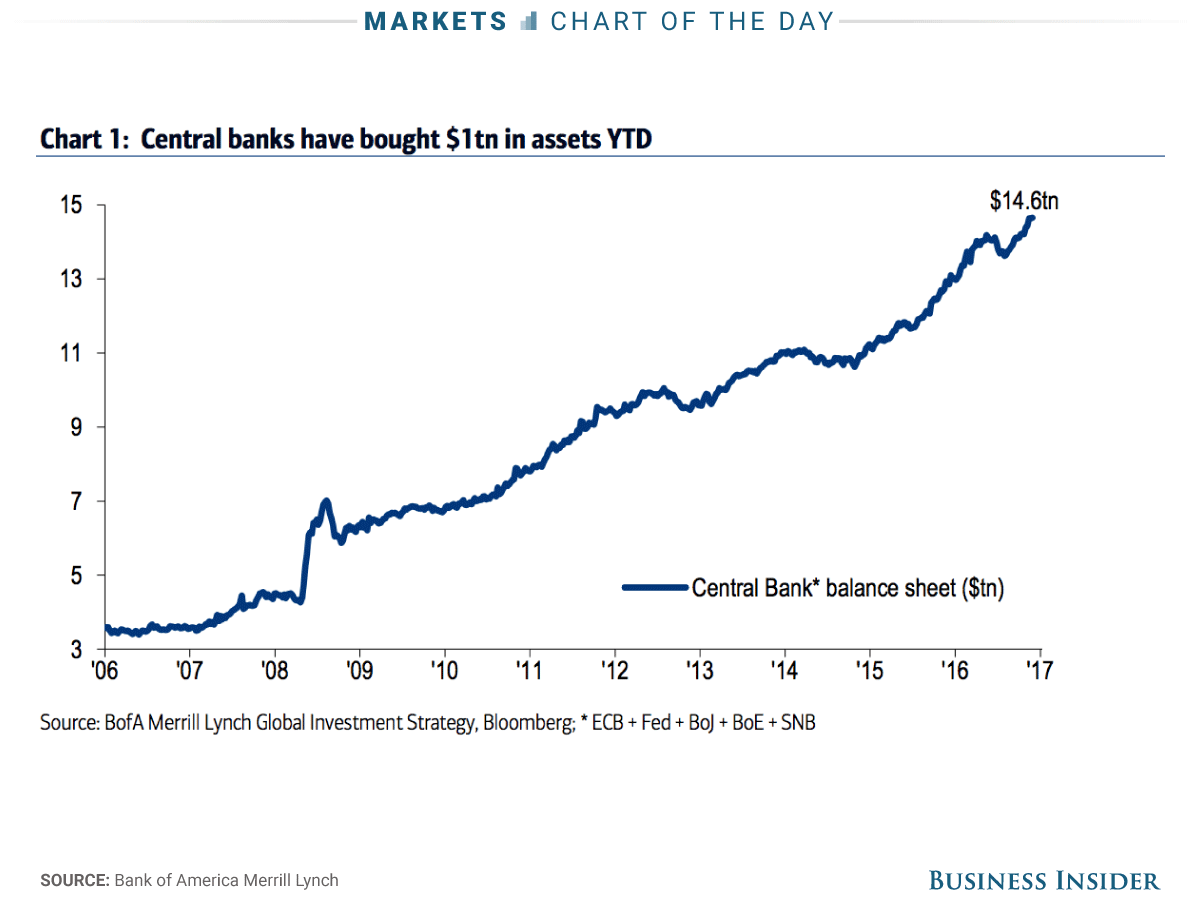
Between December 30th of last year and April 21st, the ECB grew their balance sheet by 476.5 billion euros. That is a very dramatic rate of money printing, far faster than the absurdly gargantuan sum of 60-80 billion euros per month that Draghi has promised.

Why the panic liquidity surge? I think that most are assuming that after the Brexit vote and Trump's win that central bankers have had enough with elections sowing fear, uncertainty and doubt over the financial markets. They were taking no chances with the French presidential primary.

We have arrived at a funny place in monetary history. A primary election in a minor league economy now requires a liquidity surge that is far greater than in any recession we ever saw prior to 2008.

And Europe isn't alone. The money printing by global central banks is running faster now than any time since 2008. We are nine years into our supposed recovery and central banks still feel the need to print at ever faster rates:
central bank asset purchases COTD (From Business Insider)


The conclusion that we should draw is that central bankers are trapped. They have promised that financial markets will remain elevated and stable. They won't even let a primary election in a minor economy impact financial markets. I can only imagine the response that a recession would bring.  If the rate of debasement slows it seems nearly certain that financial markets will implode. The Global Financial Crisis was so calamitous that central banks have guaranteed that it will never happen again.

Sure, there may be periods where central banks will say they are going to get tough, but no one really believes this. Here is a retail investor in China that sums up perfectly the investment wisdom of our time:

April 10 – Bloomberg: “Like many individual investors in China, Yang Mo has no idea what’s in the wealth management products that make up a big chunk of her net worth. She says there’s really no point in finding out. Sure, WMPs invest in all kinds of risky assets, but the government would never let a big one fail, she says. ‘It’s not how the Chinese government does things, and it’s not even Chinese culture,’ explains Yang, a 29-year-old public relations professional… Hers is a common refrain in Asia’s largest economy, where savers have poured $9 trillion into WMPs and similar products on the assumption that they’ll get bailed out if the investments sour. Even after news in February that policy makers are drafting rules to make it clear that state guarantees don’t exist, Yang is undaunted… ‘Cracking down on implicit guarantees is just like curbing home prices,’ she says. ‘It’s something that the government needs to say, but it’s not something they will eventually do.'"

(emphasis added)

This is where we are and it is universal. There is no fear about overpaying for assets because central bankers have their backs. Unfortunately, central banks can guarantee nominal asset prices, but only at the expense of  the eventual destruction of their currencies.  If they could stop the printing, they would have done so by now. They are trapped.

Disclaimer: Nothing on this site should be construed as investment advice. It is all merely the opinion of the author.